Showing posts with label Rolls-Royce. Show all posts

Sunday, November 21, 2010

Rolls-Royce and Bijan team up for custom Phantom line


Rolls-Royce has announced a partnership with Beverly Hills-based designer Bijan Pakzad. Bijan will work closely with the super-luxury automaker to turn out a handful of special edition Phantoms, complete with the designer's own personal touches. So far, we've been left in the dark about exactly what kinds of changes to expect, though Rolls-Royce says that Bijan will lay out a host of specifications for the company's craftsmen to meet. Considering that the designer's personal car is a bright yellow Phantom Drophead Coupe, we can bet that the new Phantoms will be anything but subdued.

Rolls-Royce and Bijan made the announcement at the Bijan Boutique in Beverly Hills – nicknamed the most expensive store in the world – just before this year's Los Angeles Auto Show got underway.

[Source: Motor Authority]

Sunday, September 5, 2010

Unique Blue Bently GT so cool

inspired by Bentley's grand touring tradition, the GT Convertible combines luxury, stunning performance and open air motoring – for up to four people.

The Continental is two cars in one: it’s an effortless, quiet, comfortable cruiser with a sumptuous interior of unrivalled craftsmanship, where wood veneers work with leather hides of the highest quality. But push the throttle and, as the exhaust note deepens, the turbocharged engine begins to demonstrate the vehicle's stunning performance.
blue Unique Blue Bently GT

Tuesday, April 13, 2010

Geely set to reveal modified Rolls-Royce aping limousine in Beijing

Geely GE Limousine


Never underestimate the power of a nose job. After getting in hot water with Rolls-Royce for the design of its GE limousine, Geely Automobile has reworked the majority of the car into what you see above. The Chinese automaker originally unveiled the GE at the 2009 Shanghai Motor Show, and the car looked like it had raided the Spirit of Ecstasy's wardrobe before hitting the stage. The engineers at Rolls-Royce were not amused, and threatened legal action unless the car underwent serious alterations.

Presumably in response to the Rolls dust-up, Geely has fitted the GE Limousine with an all-new nose, complete with a massive baleen grille and grinning headlights. The interior has also gone under the knife, and as a result, you'll no longer find a single throne in the rear. The company has opted for a much more traditional two-bucket design out back.

Expect to see the reworked GE at this year's Beijing Auto Show, along with a total of 58 other vehicles(!) from the company's three brands.


[Source: Autocar]

2 DOOR Rolls-Royce Phantom Drophead Coupe


2 DOOR Rolls-Royce Phantom Drophead Coupe


Sunday, March 28, 2010

1938 Rolls-Royce Phantom III Open Tourer - Collector Car For Sale (Click Here)


Description:
Year : 1938
Make : Rolls-Royce
Model : Phantom III
Coachbuilder : H.J. Mulliner/Hooper
Body Type : Open Tourer
Colour : Red over Black
Trim : Black Leather

History : In 1936 Rolls-Royce made their first move away from the highly successful six cylinder engine with the introduction of the Phantom III. For the first time in nearly three decades Rolls-Royce chose to power their new model with a V12 engine following several years of development. The new V12 engine was fitted with overhead valves and was capable of producing very impressive performance figures, especially when taking into account the sheer size and weight of the finished motor car. Speeds well in excess of 80mph were well within this powerful models grasp. The four speed manual gearbox was fitted with synchromesh on gears two, three and four and was very simple to operate. By 1938 two major improvements were implemented with solid adjustable tappets replacing the hydraulic units fitted in the earlier cars. Overdrive also became a standard and very welcome addition. The Phantom III was the last large Rolls-Royce produced prior to the outbreak of hostilities in 1939, with little more than 700 chassis rolling off the production line. Buyers had a vast range of coachbuilders to choose from, with a wide range of coachwork styles available. Chassis No 3DL102, which we are currently offering for sale, was delivered new to industrialist Theodore Cozzika in 1938, fitted with saloon coachwork with division by H.J. Mulliner of Chiswick London. Following Mr Cozzika’s ownership the car returned to London and was sent to the royal coachbuilders Hooper in 1950 where it was adapted into an open tourer at the request of the then owner, His Majesty the King of Greece. 3DL102 is believed to be just a three owner car as the previous owner purchased the car in 1960 from the Greek royal family and kept it in his private collection of cars for several decades. This handsome Phantom III was subject to a complete engine re-build in recent years by a highly respected marque specialist, which took place over a three year period between 1999 and 2002 resulting in a show condition engine bay with outstanding V12 on road performance. The engine is exceptionally quiet and is almost impossible to hear when in a stationary position. Its performance whilst in operation is quite exceptional, with a great deal of power at the driver’s disposal, complemented by smooth and effortless transmission through the gears. It comes fitted with a single side mounted spare wheel, twin flag masts and two occasional seats in the rear compartment. This superb motor car is in excellent cosmetic condition having been recently re-trimmed in the finest leather. The woodwork, bright work and coachwork are also in excellent order. It is complete with a large history file documenting the cars maintenance and restoration schedule. 3DL102 is an outstanding Phantom III in restored condition and ready for the next owner’s immediate use.

1935 Rolls-Royce Phantom II Sedanca Coupe - Collector Car For Sale (Click Here)


Description:
Year : 1935
Make : Rolls-Royce
Model : Phantom II
Coachbuilder : Windovers
Body Type : Sedanca Coupe
Colour : Garnet and Burgundy
Trim : Burgundy Leather

History : 1929 saw the arrival of the Rolls-Royce Phantom II which set new standards for others to follow. It was a vehicle specifically designed with the chauffer driven passenger in mind. At the time the only home produced rival to compare with the Phantom II was the Bentley 8 Litre, which was a faster vehicle but was thought to be far less chauffer friendly, with considerably heavier steering and a gearbox which was more difficult to operate. The vast majority of the 1,400 or so Phantom II chassis that were produced between 1929 and 1935 were fitted with four door saloon style coachwork, ideal for a chauffer and his passengers. However a select few were fitted with more stylish coachwork, and in our opinion few came better than Chassis No 197TA which is fitted with a “special” sedanca coupe design by Windovers of Colindale North London. The TA series cars were some of the very last built (only approximately 40 UK series chassis proceeded the TA series cars) and this particular car benefits from synchromesh gears on not only third and fourth gear, but also second gear as well; an improvement that was introduced in 1935. Chassis No 197TA was supplied from Windovers Central London showroom in Conduit Street, Mayfair (they were authorised Rolls-Royce and Bentley agents at this time) to a Captain Francis Francis. We understand that the car became the property of European nobility and was restored to concours condition for them some twenty five years ago (restoration details to follow shortly) It has clearly been sparingly used in the ensuing years as it still presents beautifully in every respect. It became part of one of the world’s most significant collections of desirable automobiles in recent years and was on display in the United States until returning to London quite recently. Chassis No 197TA is fitted with twin side mounted spare wheels, vanity mirrors to the rear compartment and a luggage rack that attached to the rear of the car below the tail mounted trunk. This unique Phantom II presents and drives beautifully and comes highly recommended by all at Frank Dale & Stepsons.

Condition : An older restoration that has been sparingly used and still presents beautifully.
Technical Data : Four speed manual gearbox, 6 cylinder in-line engine, 7.7 litres displacement, 7,668cc capacity. Servo-assisted brakes.

2008 Rolls-Royce Phantom Sapphire Edition Saloon - Classic Car For Sale (Click Here)


Description:
Year: 2008 (08) Previous Owners: 1 From New First Registered: 06.06.08 Transmission: Auto Doors: 4 Seats: 4 Colour: Madeira Polyneon 40 – colour 1976 MOT: Not App Service History: FRRSH Mileage: 3500 Engine: 6749 Fuel: Petrol Displacement: 453 bhp Top Speed: 149 0-60: 5.7 seconds Trim: Cream hide Tax: 6 Months Warranty: 3 Years Manfactures

This Roll Royce Phantom Is a Bespoke "Sapphire Edition" Costing £320.000 New !!!
1 Owner from new with his chauffeur covering 3500 miles.

Please read the huge specification below

Motor Car/Option Description
Coolbox for Lounge Seats
21" Aluminium Wheels
Walnut Burr
Voice Processing System
Six-DVD Changer
Navi-DVD Europe
Slide/Tilt Sunroof
Theatre- Lounge Seat
Preparation Mobile Phone

Bespoke Options
****PHANTOM SAPPHIRE****
RR-Logo stitched in all four headrests with sewing thread colour
Navy Blue (Madeira Polyneon 40 – colour 1976)
(Font height/30mm)
Upper Door Grab Handles in Navy Blue Leather (front & rear)
Lids of centre console(s) in Leather Navy Blue
Starlight headlining in Navy Blue Leather with front headlining inset in perforated Navy Blue Leather
Diamond Marquetry for Walnut Burr Veneer
Design & Size as per Design release
Front Cup Holder Lid in Walnut Burr Veneer
Cupholder for Lounge Seat Coolbox including flute holder
Glass storage for lounge seat on parcel shelf.
Includes x2 Tumblers
Includes x2 Flutes
Glassware for Phantom Sapphire
Illuminated tread plates Phantom Sapphire on all 4 door sills
As per design release
Chassis number plate on B-post
Phantom Sapphire glovebox embossing
Presentation box for Phantom Sapphire
Includes: x2 Phantom Sapphire Key Fobs
Includes: x1 Phantom Sapphire Conway Stewart Pen
Phantom Sapphire Clock Face
**Mono Doors in Natural Grain Leather throughout**
Door Panels in natural grain leather – Seashell
Door panniers in natural grain leather – Seashell
Carpet & Lambswool rugs in Navy Blue
Front centre console in Natural Grain leather Seashell
**In combination with option RS1 (Individual Seats)**
**Rear centre console in Natural Grain Leather Seashell**
IP-Top in preshrunk leather Navy Blue Seashell
- Top part of Instrument Panel in Preshrunk leather Navy Blue
- Lower (Inner) part including centre cross bar in preshrunk leather Seashell
Stitching in Navy Blue
Air vents in Navy Blue
Front part of hat shelf in preshrunk leather Navy Blue
Boot trim carpet in Navy Blue
Remainder of Interior in Seashell as RAT6
Seat Piping in Navy Blue applied to the following areas:
Front Seats Left & Right
Lounge Seat or Individual Seats depending on configuration
Headrests Front & Rear
Armrests in front doors (left & right) in natural grain leather Navy Blue
Rear outer armrests (left & right) in natural grain leather Navy Blue
C/D Pillar surrounding rear mirror & door retract button, above rear seat squab in natural grain leather Seashell

Dealer Options
TV function
DVD Code 2 (EUR/ME/JPN/SA)
Country Spec GB/Ire
Cross-over operation, deletion
English Owners Handbook
Deletion Transport Protection
Order code – Bespoke feature
Veneered Instrument Panel
Colour-keyed Boot Trim
RR monogram to all headrests
Blue Chrome option
Universal garage door opener
Parking Air Conditioning
Camera system

Saturday, March 27, 2010

1926 Rolls-Royce Phantom I Open Tourer - Collector Car For Sale (Click Here)


Description:
Year : 1926
Make : Rolls-Royce
Model : Phantom I
Coachbuilder : Windovers
Body Type : Open Tourer
Colour : Wedgewood Blue over Black
Trim : Black Leather

History : By 1925 the exceptionally successful eighteen year production run of the Silver Ghost had firmly put Rolls-Royce at the forefront of motor car production. The term “The Best Car in the World” had been deservingly earnt thanks to the soundness of its design and the pain staking lengths the Rolls-Royce engineers and workmen went to during construction. It is fair to say that the Ghost’s efficiency, reliability and superb performance were unmatched at the time. Its reputation laid the foundations for the continued success of the company and following seven years of development on the 2nd of May 1925 a new chapter began with the introduction of the New Phantom, which later became known as the Phantom I. One major improvement over the Silver Ghost was the introduction of the pushrod operated overhead valve engine. Three groups of two cylinders with detachable heads powered the 7.7 litre engine, producing rapid acceleration and the ability to maintain high speeds for periods of time “undreamt of before.” The New Phantom was able to produce 33% greater horse power at just over 2,000 rpm than its predecessor, thanks to a number of mechanical improvements. The New Phantom was a great success and was considered to be a very worthy successor to the Silver Ghost. Production lasted until early 1930 with a total of 2,269 chassis produced on English soil whilst a little more than 1,200 further chassis were produced at the Rolls-Royce factory in Springfield, Massachusetts in the United States. The standard chassis rolled off the production line with a price tag of £1,850 and then it was up to the new owner to instruct the coachbuilder of his/her choice to construct coachwork to their taste. Windovers factory in Colindale, North London was particularly prolific in production terms during the 1920’s following their relocation from Huntingdon producing a wide range of bodies for the New Phantom chassis. Windovers were responsible for bodying just over twenty open tourer bodies for the Phantom I chassis identical to Chassis No 132LC which we are proud to be offering for sale at this time. Windovers work was admired by a number of the Indian Princes and it should be noted that identical open tourer bodies were crafted for the likes of the Maharajah of Nanpara and the Maharajah of Kashmir. His Highness the Kumar of Viziangaram also had such a body constructed by Windovers but chose solid gold and silver fittings as opposed to the standard nickel finish. Well.....if you can afford it, why not. Chassis No 132LC was originally delivered on the 27th of May 1926 to Mr Taylor of Tadworth in Surrey finished as is it is today, in Wedgewood blue over black with a black hood. 132LC appears to have spent lengthy periods of time in both England and the United States of America. At some point prior to the 1960’s the coachwork was re-painted yellow and black. However it was restored to its original configuration of blue over black during a high quality restoration some decades ago whilst in England. Records show that 132LC returned to the United States in the late 1960’s before returning to British shores in around 1990. It has since spent one further period of time on American soil before returning to London quite recently. The car comes complete with its rear screens and full all weather gear including side screens, a detachable tail mounted trunk and copies of the original factory build sheets and chassis cards. The restoration has stood the test of time well and the car still presents beautifully. Having been mechanically reviewed and tuned by our engineers we can report that this superb motor cars on road performance is exceptional and is ready to be used for touring if so desired. In our opinion this magnificent pre-war Rolls-Royce will surely serve its next proud owner with distinction.

Condition : An older restoration that has stood the test of time very well. In very good order throughout.

Technical Data : Four speed manual gearbox, 6 cylinder in-line engine, 7.7 litres displacement, 7,668cc capacity. Servo-assisted brakes.

Sunday, March 7, 2010

Geneva 2010: Mansory Rolls-Royce Ghost

Mansory Rolls-Royce Ghost

We previously mentioned in our coverage of the 2010 Geneva Motor Show that a blue and yellow color combination was a potential recipe for disaster. As proof, we present to you the Mansory Rolls-Royce Ghost. Ok, so it's technically blue and gold, but that just might make it worse. The Swiss tuner has long been known for its controversial styling, and this vehicle follows a long line of shocking cars like the Bentley Vitesse Rose that debuted at Frankfurt. That's not to say we haven't liked anything produced by Mansory. We very much dug the Linea Vincero that appeared at this show last year.

Is there anything we like about the blue baby Rolls? We can perhaps appreciate the larger turbochargers and upgraded exhaust system that boost horsepower to 720. Other than that we wouldn't touch it with a ten foot pole. What Mansory calls "self assured coloring" we simply call garish, and the "styling interior refinements" are anything but. Thanks, but no thanks. We'll keep our Rolls-Royce Ghost as is.

Wednesday, September 16, 2009

Frankfurt 2009: 2011 Rolls-Royce Ghost

2011 Rolls-Royce Ghost

Perhaps with conspicuous consumption falling out of favor, you're looking to downsize from your Phantom. Perhaps you're Kanye West and you feel the need to lower your public profile, but you don't want to give up your Roller's famously coddling ride. Well, B-list celebrities and hangers-on, Rolls-Royce has your number, and it's called the Ghost.

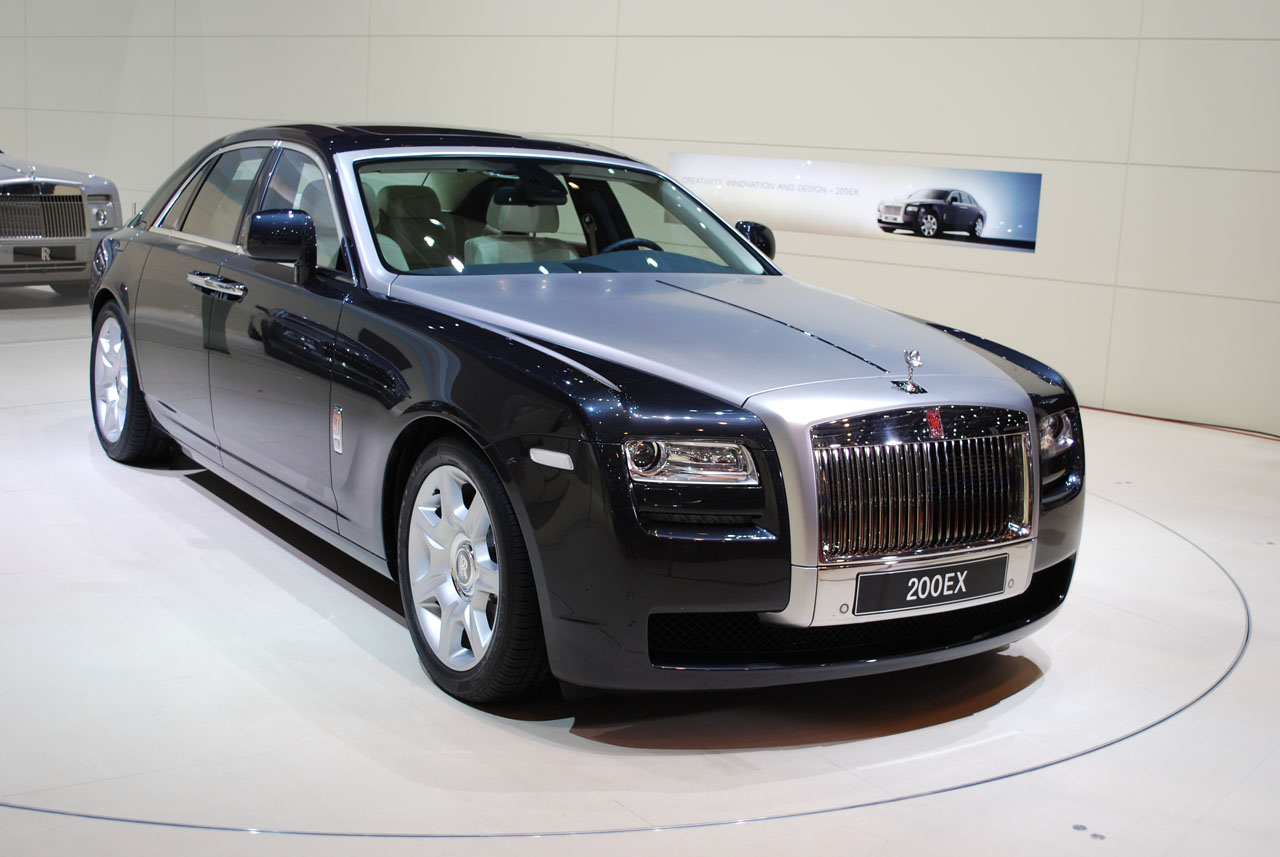
Looking quite a bit like Geneva's 200EX showcar, the Ghost made its public debut here in Frankfurt, and while we may kid prospective owners that the Ghost is not the Brit brand's top-shelf offering, there's no shame in this car's game. After all, it's hard to consider anything of this scale a "baby," particularly when it's packing a 6.6-liter V12 putting down 563 brake horsepower. What's more, it doesn't actually look that small, even when placed in a row shoulder-to-shoulder with its big brother.

As with the Phantom, rectilinear styling, an impossibly high beltline, and suicide doors are the stylistic meme of this Ghost, although this sedan manages to look somewhat lighter and modestly more athletic than its senior stablemates. Suffice it to say that if you've got a spot for the Phantom in your dream car garage, the Ghost ought not be far behind. If you loath the Phantom's imposing scale and bank vault styling, you're probably unlikely to warm to this latest family member – at least until you are ensconced inside its leather-lined, air-suspended confines.

[Source: Rolls-Royce]


PRESS RELEASE:

INTRODUCTION


Autumn 2006, Paris motor show: Rolls-Royce Motor Cars announced that work had begun on a new model series. The new car would be in production and on sale by the turn of the decade. The only other facts confirmed at that stage were that it would be smaller than the Phantom saloon and priced somewhere between €200,000 and €300,000 before tax. Speculation about its style and specification began almost immediately...

Little was seen of the new car, codenamed RR4, until the spring of 2008, when Rolls-Royce released the first official sketches. The styling was instantly recognisable as a Rolls-Royce, although less traditional than previous models. At the time Chief Designer, Ian Cameron, said, "The RR4 has a more informal presence than the Phantom models with a greater emphasis on driving. In design terms this is expressed through its slightly smaller dimensions, yet with powerful, purposeful proportions. It is a true and uncompromising Rolls-Royce in every sense."

As sightings of secret development models on the road increased, Rolls-Royce Motor Cars unveiled 200EX, the experimental forerunner to Ghost, at the Geneva motor show in March 2009. An instant hit, 200EX bore the trademark Rolls-Royce design cues but in altogether more compelling fashion. It was a clear statement of intent.

What the design team was seeking to create was a modern Rolls-Royce that achieved a new dynamism but remained true to its luxurious heritage. They had found inspiration in contemporary furniture, architecture and yachts but also in the spirit of the 1930s – that sense of adventure and endeavour – which they wanted to capture in the character of this new car.

"200EX is a modern execution of timeless Rolls-Royce elegance, breaking with some areas of tradition but retaining the core values that make our marque unique," said Chief Executive Officer Tom Purves. "We expect the more informal design to broaden the appeal of Rolls-Royce Motor Cars, attracting people who appreciate its fusion of refinement, new technology and contemporary style."

After the show, 200EX embarked on a world tour, during which further information about the forthcoming production model became available. It would be powered by a new 6.6 litre V12 unique to the marque, delivering 563 bhp with extraordinary performance figures. It would ride on an intelligent air suspension system offering peerless ride and dynamics. And it would be called Ghost.

"Ghost is one of the most revered names in automotive industry," said Tom Purves. "It evokes images of adventure and technical innovation. The first cars to bear the Ghost name were known not only for impressive dependability and refinement but also great flair and style."

Following the overwhelmingly positive reaction to 200EX during its travels, very few changes were made in the transition to the production Ghost – a tribute to the remarkable achievements of Ian Cameron's and Helmut Riedl's design and engineering teams.


In September 2009, the new Rolls-Royce Ghost was formally launched to the world.

DESIGNING THE FUTURE

"Simplicity is the hardest design principle to follow."
Ian Cameron, Chief Designer

Ghost's flowing lines are dominated by its majestic 'Yacht Line' styling. Large, uninterrupted surfaces flow between finely sculpted horizontal lines that provide definition. Together, the upward-sweeping sill line and low-cut roof create a powerful profile, almost as though the cabin has been pushed toward the rear. Powerful shoulders and flanks draw in sharply as they flow from the rear wings to the tail lights, while touches such as the optional chromed exhausts hint at Ghost's more dynamic nature.

While incorporating classic Rolls-Royce design cues – the elevated prow, long bonnet, short front overhang, sharply raked A-pillar and elegant tail – Ghost exudes an informal aura. Contemporary touches include self-righting wheel centres and the Xenon headlamps that frame the latest evolution of the Rolls-Royce grille. Here the sides of the intake have been curved inwards and the vanes set back into the opening. "We wanted this to be less reminiscent of the traditional Parthenon style and more like a jet intake," says Ian Cameron.

A contrasting Silver Satin finish (introduced on 200EX) is an option for the bonnet, grille and windscreen surround. The finish is achieved by setting silver metallic paint under a layer of lacquer, giving a flawless matte finish.

The central principle of delivering simplicity out of complexity runs throughout Ghost. Everything is designed, engineered and crafted to enhance the drive and ride experience, not to complicate it.

"Ghost is as refined and cosseting as anything this marque has ever produced."
Charles Coldham, Interior Designer

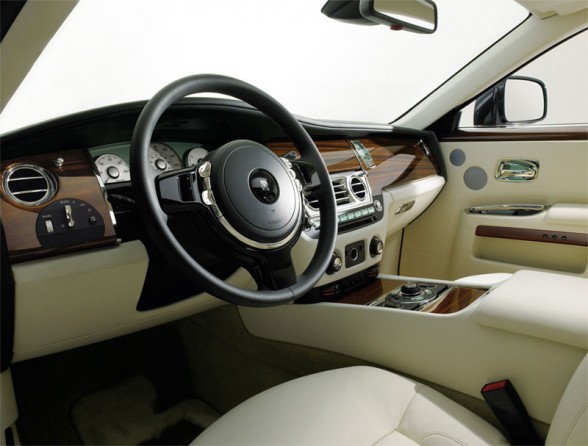
Inside Ghost, the interior design team has come up with a contemporary ambience while staying true to Rolls-Royce Motor Cars' traditions of fine materials and peerless comfort. There are elegant, frosted lamps and chrome door handles, traditional violin key switches and eyeball air vents, frosted white dials and refined instrumentation. Deep-pile carpets can be complemented by optional lambswool floor mats for a truly luxurious feel.

Ghost is entered through substantial doors. Housed within the front doors are integrated Teflon-coated umbrellas. The rear doors are traditional, rear-hinged coach doors, opening to a generous 83 degrees. Once the passenger is inside, these doors can be closed at the touch of a button. The interior space is filled with natural light, enhanced by the optional Panorama Sunroof, which extends from the front into the rear compartment.

Four-zone automatic air conditioning can be individually tailored to each passenger's requirements, with separate controls for front and rear. Automatic air recirculation, condensation prevention and solar compensation are delivered through classic chromed eyeball vents controlled via organ-stop plungers.

Within Ghost's ample doors and high shoulder line, occupants feel serene, cosseted and safe. In the rear, the intimate ambience of the lounge seat is emphasised by its position behind the C-pillar, heightening the sense of privacy. The informal seating creates a convivial environment, its slight curve allowing you to turn more easily towards the person next to you. Its elevated position gives a clear view past the electronically retracting Spirit of Ecstasy to the road ahead.

Individual lounge seating is offered as an alternative to the standard lounge configuration. This allows the addition of a massage function and also perforated leather for a cooling stream of air from the seat surface. Auxiliary rear climate control allows the passenger to regulate the temperature of the air on their side of the car, without intrusion on the other. A cool box with interior illumination and integrated champagne glasses is also available.

Veneered picnic tables are another option, incorporating the finest leather and veneers matched to the rest of Ghost's interior. Fitted to the rear of each front seat, these tables are a traditional Rolls-Royce design cue and finished with a veneered surface with leather-covered backs.

"Ghost is designed to be an escape from the outside world."
Alan Sheppard, Interior Designer


Enhancing the Ghost ambience is an audio system delivering an exquisite experience. 600 Watts of sound are delivered through a 10-channel amplifier and 16 speakers, including two floor-mounted subwoofers. USB and auxiliary inputs allow for the integration of external audio devices and a 12.5 GB hard drive enables storage of music files from USB or CD player sources.

Available as an option with both seating arrangements is Theatre Configuration, which allows all settings that do not directly affect the driver to be controlled from the rear seat. The functions are displayed on two 9.2in LCD screens in the back of the front seats; these can be angled to suit the viewers by a central, armrest-mounted, rotary controller. The screens can be regulated independently of each other and the entertainment can also be listened to individually with most headphones. A six-disc multi-media changer, mounted in the glove compartment, is fitted as part of this option.

ENGINEERING A BENCHMARK

"The balance of refinement and dynamic ability is astonishing."
Helmut Riedl, Engineering Director

When considering a Rolls-Royce car it is usual to think of wood, leather and chrome, but the company has its roots in engineering. The refinement of its end product stems from its engineers' desire to get the smallest details correct. Long before the interior items are prepared, experts are working to ensure that the chassis components, power trains and bodywork are operating in fluid harmony. This is a world where welds are an art form and craftsmanship exists at a nano level.


Ghost is built around a steel monocoque body, which means there is no separation of chassis and body. The advantage of this construction is a reduction in exterior dimensions while preserving interior space. Consequently while Ghost is over 400mm shorter overall than the Phantom saloon its interior space is comparable.

The body has been engineered with a double front bulkhead to help insulate the interior from engine noise. It is constructed from steel sections and then wrapped in steel panels, which are brazed by hand. This allows a near-seamless join, which is then sanded by hand until it is perfect. In total, Ghost's frame contains 4.9m of seam weld and braze and 6,988 spot-welds. The bonnet and windscreen surround are then honed from aluminium.

"A Rolls-Royce should be graceful in every way: the way it handles, feels and brakes."
Helmut Riedl, Engineering Director

Ghost rides on a bed of air. Double-wishbone front suspension and multi-link rear suspension work with an intelligent, four-cornered, air-suspension system and electronic variable damping to deliver the refinement that has been associated with Rolls-Royce for more than 100 years.

The new air suspension system in Ghost is so sensitive that it can detect even the smallest of changes. For example, it will sense the movement of a single rear passenger from one side of the seat to the other and compensate accordingly. A complex computer system reads multiple inputs from sensors around the car; the dampers alone make individual load calculations every 2.5 milliseconds. This ensures not only perfect comfort but also precise steering and dynamics for the driver. The air suspension system also incorporates a lift and kneel function, raising or lowering Ghost by 25mm.

Ghost also has a series of complex electronic aids to keep it composed on virtually any surface. These include Anti-Roll Stabilisation, Dynamic Brake Control and Dynamic Stability Control, including Dynamic Traction Control and Cornering Brake Control. These individual technologies work together under dual Integrated Chassis Management systems, meaning that even when subjected to a vigorous test Ghost remains perfectly poised. Its handling and safety systems operate as one, imperceptibly to the driver and passengers, to maintain optimum contact with the road in any condition.

"Our challenge," says Engineering Director Helmut Riedl, "has been to preserve the prerequisite levels of comfort while delivering the most modern, dynamically interesting drive ever in a Rolls-Royce."

Ghost is powered by a brand new, 6.6 litre twin-turbo V12 engine, unique to the model. Featuring direct injection, it produces 563bhp – enough to propel Ghost from 0-60 mph in just 4.7 seconds* and on to an electronically governed top speed of 155mph. With 780 Nm of torque available at just 1,500rpm, delivery of power is immediate and extremely smooth.

Power is transmitted through an eight-speed, shift-by-wire, automatic ZF gearbox. What this achieves is a feeling of endless, surging power, which is illustrated by the power reserve gauge on the fascia, replacing the more common rev counter. The new powertrain delivers this performance while emitting just 317g/km of CO2.Fuel consumption is 20.8 mpg / 13.6 l/100km.*

Safety remains paramount and the very latest technologies are used in Ghost. Side-impact beams in the front and rear doors combine with progressive rear crumple zones to absorb impacts. The Advanced Crash and Safety Management (ACSM) system takes measurements 2,000 times per second from sensors located around the vehicle. The ACSM uses this information – in conjunction with the engine and chassis management systems – to judge which safety features to deploy in which areas in the event of an accident. If necessary, ACSM will activate – among other things – seatbelt pre-tensioners and all encompassing airbags surrounding the cabin, creating a safe zone for all occupants.

A MODERN ROLLS-ROYCE

Ghost is the most powerful car that Rolls-Royce Motor Cars has ever produced. However, Rolls-Royce power is delivered in a very different manner to other cars. It arrives in an elegant, cosseting way that some have described as being designed to lower the pulse, not raise it.

The principle of simplicity extends to the act of driving Ghost. The host of complex engineering software and technologies beneath the surface serve to make driving easier and more enjoyable, not to intrude or confuse.

"Nothing should distract from the pleasure of driving Ghost."
Helmut Riedl, Engineering Director

Ghost is more driver-focused than any Rolls-Royce car before it. The driver sits in a slightly elevated position behind the wheel, described as the authority position. This makes the view of the road much clearer. The fascia has been kept deliberately clear; it is spacious in design and has an intuitive layout. The controls are neatly sculpted, with the more important functions emphasised by accents of chrome. The soft light of the instrument panel glows through the familiar black-rimmed steering wheel, which in turn employs a number of violin keys as well as an ergonomic roller-ball control.

The control centre display is concealed behind a veneered panel until its services are called upon. All features such as satellite navigation, telephone, communication and entertainment functions are displayed here and managed via a central rotary controller, flanked by quick-access buttons on the front centre console.

The optional driver assistance systems and technologies in Ghost are notable for their discretion and ease of operation. From the moment the driver approaches the car, optional Comfort Entry** allows easy access, unlocking the doors when the key fob is within 1.5 metres and the cool chromed handle is grasped. Once you are in the car, voice control allows you to select from the control systems menus without using the central controller.

For ease of manoeuvring, cameras located around the car serve a number of purposes. Rear, front side and top view cameras can combine to give a fish-eye view at blind junctions or provide ground images with obstacle recognition and reverse path prediction when parking.

Positioned discreetly within the grille is a Night Vision** camera. When activated, this safety feature works with Pedestrian Recognition to detect objects up to 300 metres away and display them on the central screen in the dash. The car's control system receives infrared heat images from the camera and, taking into account the car's speed and direction, classifies them to assess imminent danger. It then determines what action, if any, needs to be taken and if necessary displays a warning to the driver.

The Head-up Display relays crucial information such as speed or navigation directions onto the windscreen directly in front of the driver. This information is visible only to the driver and can be tailored to show only the details required and at a position suitable to the driver.

Lane Departure Warning** alerts the driver should the car start to drift out of its current lane. When activated, it uses an integrated camera, located just in front of the rear view mirror, to monitor road markings and the vehicle's position. The driver is warned by a discreet vibration through the steering wheel. If the driver uses the directional indicators before and after the lane change, the wheel will not vibrate.

High Beam Assistance** automatically manages the operation of dipped and main beam lights while driving at night. When activated, the same camera used by the Lane Departure Warning system monitors the light from any source at the front of the vehicle and automatically dips or raises the headlights accordingly. Adaptive, directional headlights also improve illumination of the road ahead and adapt to the road conditions, be they rain or fog or simply when the car is making a turn.

Active Cruise Control with Stop & Go** creates a relaxing driving experience, particularly on long cruising journeys, as action is not required when the car ahead speeds up or slows down, even when coming to a standstill. Active Brake Intervention** also allows hill descent at a constant speed and the car's Curve Speed Limiter communicates with the car's Dynamic Stability Control systems to reduce speed on bends if safety and comfort may be compromised.

LEGENDARY CRAFTSMANSHIP

Rolls-Royce has a reputation for producing cars that transcend the mere automotive. There is a magic attached to the name, which stems in part from exquisite attention to detail and the fine materials used throughout.

Passing through 60 pairs of hands, the production process involves more than 2,000 individual operations and takes at least 20 days to complete.

"We don't just paint our cars, we strive to create an incredibly deep, flawless shine."
Lisa Taylor, Paint Associate

Ghost shares the same paint shop as Phantom and spends seven days being painted and polished to perfection. Five stages are required for the Ghost body. First a phosphate electro-coat is applied to protect against corrosion, then a layer of primer, a colour coat and finally two coats of clear lacquer. The body is hand-sanded between each layer and once the final coat is applied it is hand-polished for five hours.

Ghost is available in 12 exterior colours, each of which can be contrasted by the optional Silver Satin bonnet.

Flawless leather is an absolute requirement for the interior of a Rolls-Royce. For this reason, our leather is sourced from bulls raised in pastures free of barbed wire, ensuring that there are fewer imperfections in the leather. Any other marks are carefully avoided by our skilled laser cutters. At least eight hides are used for an interior, and to ensure colour consistency, each hide comes from a batch dyed at the same time. The hides are drum-dyed rather than painted, ensuring that the colour permeates right through the leather. The process also means the leather remains much more supple, preventing cracking or squeaking and ensuring durability and longevity. All seats and interior panels are hand-stitched, using traditional upholstering techniques by those most skilled at their craft.

The natural beauty of the veneers in Ghost is brought to life by the skill of dedicated craftsmen and women. The natural burrs and grains are chosen for their intricacy and interest: veneer specialists choose only the finest logs from which these very thin cross sections are taken. Only veneer from one tree is used in any car. This ensures not only that the grain matches throughout the interior, but that each area ages and colours at the same pace. The parts are milled and sanded by hand before being coated with five layers of lacquer for protection and a mirror-like shine.

EPILOGUE

Ghost is a vision of simplicity – of taking the core values of Rolls-Royce and creating contemporary effortless luxury. Ghost has been engineered to ride and drive in peerless fashion. The chassis' poise delivers a dynamically engaging experience for the driver, yet a serene, comfortable ride for passengers. Engine power is delivered in a manner which has become an engineering signature, seemingly effortlessly and endlessly. The latest in-car technology falls easily to hand while forming part of the background.

Ghost embodies 21st-century Rolls-Royce: more than 100 years of engineering and design excellence expressed in modern and uncompromised style.

*Rest of World specification – figures for North America can be found in the technical specification

** Option not available in some markets due to legal restrictions

Colour, trim and options

Exterior colours:

Adriatic Blue

Claret

Darkest Tungsten

Dark Indigo

Diamond Black

English White

Ensign Red

Jubilee Silver

Lunar Blue

Metropolitan Blue

New Sable

Sea Green


Leather colours

Black

Consort Red

Crème light

Dark Spice

Fleet Blue

Moccasin

Pine Green

Seashell


Veneers

Elm Cluster

Dark Wenge

Malabar

Piano Black

Walnut Burr


Technical specification

Rest of World:

Number of doors / seats

-

4 / 5

Vehicle length (unladen)

mm

5399

Vehicle width (unladen)

mm

1948

Vehicle height (unladen)

mm

1550

Wheelbase

mm

3295

Turning circle

m

13.4

Overhang front

mm

867.5

Overhang rear

mm

1236.5

Track width front

mm

1622

Track width rear

mm

1660

Shoulder room front

mm

1510

Shoulder room rear

mm

1418

Elbow room front

mm

1540

Elbow room rear

mm

1448

Max headroom front

mm

1030

Max headroom rear

mm

990

Effective headroom front with sunroof

mm

995

Effective headroom rear with sunroof

mm

975

Ground clearance (unladen)

mm

150

Width including mirrors

mm

2108

Luggage compartment capacity (ISO3832)

ltr

490

Fuel tank capacity

ltr

82.5

Unladen weight (DIN / (EU)

kg

2360 / 2435

Axle load ratio, rear (unladen)

%

48.2

Gross axle weight /max payload

kg

2940 / 580

Axle payload limit front / rear

kg

1445 / 1575

Engine type / Cylinders / valves

-

V / 12 / 48

Fuel management

-

Direct injection

Engine injector set-up / Aspiration


DI(VVT)/ twin turbo

Displacement

cm3

6592

Stroke / Bore

mm

88.3 / 89.0

Power output @ engine speed

bhp / kW (PS)/min-1

563 / 420 (570) / 5250

Max torque @ engine speed

lb/ft / Nm/min-1

575 / 780 / 1500

Compression ratio / fuel type

-

10.0 / Super unleaded*

Transmission type

-

8 speed automatic

Transmission ratios 1st/2nd/3rd/4th

-

4.717 / 3.143 / 2.106 / 1.667

Transmission ratios 5th/6th/7th/8th

-

1.285 / 1.000 / 0.839 / 0.667

Transmission ratio reverse gear

-

3.317

Final drive ratio

-

2.813

Steering / Total

-

Hydraulic rack and pinion 19.9

Steering wheel revolutions lock to lock


3.1

Brakes front /diameter x thickness

- / mm

Ventilated discs / 410x36

Brakes rear /diameter x thickness

- / mm

Ventilated discs / 402x30

Drag co-efficient cd / A / cd x A

- / m2 / m2

0.33 / 2.60 / 0.863

Top speed

mph / km/h

155 / 250

Acceleration 0-60 mph / 0-100km/h

s

4.7 / 4.9

1km from standing start

s

23.1

Power to weight (DIN-Unladen weight)

kg/kW

5.6

Power per litre

kW/ltr

63.7

Consumption urban (EU)

ltr/100km

20.5

Consumption extra urban

ltr/100km

9.6

Combined consumption / range

mpg (imp. gal.)/ ltr/100km

20.8 / 13.6

Range

m / km

376 / 605

CO2 Emissions (combined)

g/Km

317

Exhaust emissions standard


EU5

Front tyres

-

255/50 R19 103Y

255/45 R20 101Y

Rear tyres

-

255/50 R19 103Y

285/40 R20 104Y

Front wheels

-

8.5J x 19 EH2

8.5Jx20 EH2

Rear wheels

-

8.5J x 19 EH2

9.5Jx20 EH2

Wheel inset (difference between mounting face and centre of tyre section)

mm

25

Capacity of radiator incl. heating / motor oil

ltr

17.2 / 10.5

Transmission oil / final drive fluid

ltr

Lifetime filling

Battery capacity / location

Ah / -

90 (AGM) / Luggage compartment

Alternator output rating

A / W

210 / 2900

*The engine is designed for Octane 95 fuel


North America

No. of doors / seats

-

4 / 5


Vehicle length

mm / inch

5399 / 212.6


Vehicle width

mm / inch

1948 / 76.7


Vehicle height, unloaded

mm / inch

1550 / 61.0


Wheelbase

mm / inch

3295 / 129.7


Turning circle

m / ft

13.4 / 44.0


Track width front

mm / inch

1622 / 63.9


Track width rear

mm / inch

1660 / 65.4


Width at shoulder height, front

mm / inch

1510 / 59.4


Width at shoulder height, rear

mm / inch

1418 / 55.8


Effective leg room, front

mm / inch

1060 / 41.7


Effective leg room, rear

mm / inch

1075 / 42.3


Effective head room, front

mm / inch

1030 / 40.6


Effective head room, rear

mm / inch

990 / 39.0


Trunk volume

ltr / ft3

490 / 17.3


Trunk volume acc. SAE J1100 method

ft3

14


Approx. tank capacity

ltr / gal

82.5 / 21.8


Curb weight

kg / lbs

2470 / 5445


Axle load ratio, rear (unladen)

%

48.6


Gross vehicle weight

kg / lbs

2940 / 6482


Payload

kg / lbs

460 / 1014


Axle load limit, front

kg / lbs

1445 / 3175


Axle load limit, rear

kg / lbs

1575 / 3472


Engine / No. of cylinders / valves p. cyl.

-

V / 12 / 4


Fuel management

-

Direct injection


Engine injector set-up / Aspiration


DI(VVT)/ twin turbo

Displacement, acc. to ECE Reg.

cm3 / inch3

6592 / 402.3


Stroke

mm / inch

88.3 / 3.48


Bore

mm / inch

89.0 / 3.50


Nom. power output / Eng. speed

SAE hp / min-1

563 (420) / 5250


Max. torque / Engine speed

ft lbs / min-1

575 / 1500


Compression ratio / Fuel type

-

10.0 / Premium unleaded


Transmission type

-

8-speed automatic


Gear ratio 1st / 2nd / 3rd / 4th

-

4.717 / 3.143 / 2.106 / 1.667


Gear ratio 5th / 6th / 7th / 8th

-

1.285 / 1.000 / 0.839 / 0.667


Reverse gear ratio

-

3.317


Final drive ratio

-

2.81


Steering type

-

Rack and Pinion / 19.9


Brake front / diameter

- / mm / inch

Ventilated disc / 410 / 16.1


Brake rear / diameter

- / mm / inch

Ventilated disc / 402 / 15.8


Drag cd

-

0.33


Drag cd x A

m2 / ft2

0.863 / 9.3


Top speed

km/h / mph

250 / 155


Acceleration 0-60mph

s

4.8


Acceleration 0 - 1/4 mile

s

13.2


Acceleration 0-100 km/h (Canada)

s

5.0


Fuel consumption city

ltr/100km / mpg

TBC


Fuel consumption highway

ltr/100km / mpg

TBC


Fuel consumption combined

ltr/100km / mpg

TBC


Approx. range

km / miles

TBC


acc. EPA (fuel economy guide)

city/highway/comb.

TBC


Front tyres

-

255/50 R19 103Y

255/45 R20 101Y


Rear tyres

-

255/50 R19 103Y

285/40 R20 104Y


Front wheels

-

8.5J x 19 EH2

8.5Jx20 EH2


Rear wheels

-

8.5J x 19 EH2

9.5Jx20 EH2


Radiator incl. heater / Engine oil

ltr / quarts

17.2/18.2 / 10.5/11.1


Transmission fluid / Final drive fluid

ltr / quarts

Life-time


Battery capacity / installed position

Ah / -

90 (AGM) / luggage compartment


Alternator output rating

A / W

210 / 2900

Monday, September 7, 2009

Officially Official: 2011 Rolls-Royce Ghost details released

2011 Rolls-Royce Ghost

Rolls-Royce has officially dropped dozens of images and plenty of details on its new "baby" saloon, the Ghost. The new Roller won't be seen publicly for another week, when it'll formally bow in Frankfurt, but we now know that its 6.6-liter V12 generates an impressive 575 lb-ft of torque at 1,500 rpm, along with 563 horsepower in U.S. trim. The 212.6-inch body stretches over a 129.7 inch long wheelbase, and the whole car weighs in at 5,445 pounds unloaded.

There are no surprises in the styling, which is unchanged from the 200EX concept displayed in Geneva last March. naturally, the Ghost retains the Phantom-style coach doors (don't call them suicide in the presence of a Rolls rep) with built-in umbrellas. Inside, the Ghost carries over additional Phantom quirks, such as the "Power Reserve" gauge the driver gets in lieu of a traditional tachometer. Aside from that, this is clearly more of a driver's car than the Phantom, whose opulent backseat accommodations show that it's more about being driven in. The Ghost's steering wheel is much smaller in diameter and has a thicker rim than its big brother, and the seats appear to have more contouring for lateral support, as well. Pricing hasn't been announced yet, but plan on bringing a Halliburton attache case full of cash if you plan on buying one,

[Source: Rolls-Royce]

PRESS RELEASE:

ROLLS-ROYCE GHOST
INTRODUCTION

Autumn 2006, Paris motor show: Rolls-Royce Motor Cars announced that work had begun on a new model series. The new car would be in production and on sale by the turn of the decade. The only other facts confirmed at that stage were that it would be smaller than the Phantom saloon and priced somewhere between €200,000 and €300,000 before tax. Speculation about its style and specification began almost immediately...

Little was seen of the new car, codenamed RR4, until the spring of 2008, when Rolls-Royce released the first official sketches. The styling was instantly recognisable as a Rolls-Royce, although less traditional than previous models. At the time Chief Designer, Ian Cameron, said, "The RR4 has a more informal presence than the Phantom models with a greater emphasis on driving. In design terms this is expressed through its slightly smaller dimensions, yet with powerful, purposeful proportions. It is a true and uncompromising Rolls-Royce in every sense."

As sightings of secret development models on the road increased, Rolls-Royce Motor Cars unveiled 200EX, the experimental forerunner to Ghost, at the Geneva motor show in March 2009. An instant hit, 200EX bore the trademark Rolls-Royce design cues but in altogether more compelling fashion. It was a clear statement of intent.

What the design team was seeking to create was a modern Rolls-Royce that achieved a new dynamism but remained true to its luxurious heritage. They had found inspiration in contemporary furniture, architecture and yachts but also in the spirit of the 1930s – that sense of adventure and endeavour – which they wanted to capture in the character of this new car.

"200EX is a modern execution of timeless Rolls-Royce elegance, breaking with some areas of tradition but retaining the core values that make our marque unique," said Chief Executive Officer Tom Purves. "We expect the more informal design to broaden the appeal of Rolls-Royce Motor Cars, attracting people who appreciate its fusion of refinement, new technology and contemporary style."

After the show, 200EX embarked on a world tour, during which further information about the forthcoming production model became available. It would be powered by a new 6.6 litre V12 unique to the marque, delivering 563 bhp with extraordinary performance figures. It would ride on an intelligent air suspension system offering peerless ride and dynamics. And it would be called Ghost.

"Ghost is one of the most revered names in automotive industry," said Tom Purves. "It evokes images of adventure and technical innovation. The first cars to bear the Ghost name were known not only for impressive dependability and refinement but also great flair and style."

Following the overwhelmingly positive reaction to 200EX during its travels, very few changes were made in the transition to the production Ghost – a tribute to the remarkable achievements of Ian Cameron's and Helmut Riedl's design and engineering teams.

In September 2009, the new Rolls-Royce Ghost was formally launched to the world.

DESIGNING THE FUTURE

"Simplicity is the hardest design principle to follow."
Ian Cameron, Chief Designer

Ghost's flowing lines are dominated by its majestic 'Yacht Line' styling. Large, uninterrupted surfaces flow between finely sculpted horizontal lines that provide definition. Together, the upward-sweeping sill line and low-cut roof create a powerful profile, almost as though the cabin has been pushed toward the rear. Powerful shoulders and flanks draw in sharply as they flow from the rear wings to the tail lights, while touches such as the optional chromed exhausts hint at Ghost's more dynamic nature.

While incorporating classic Rolls-Royce design cues – the elevated prow, long bonnet, short front overhang, sharply raked A-pillar and elegant tail – Ghost exudes an informal aura. Contemporary touches include self-righting wheel centres and the Xenon headlamps that frame the latest evolution of the Rolls-Royce grille. Here the sides of the intake have been curved inwards and the vanes set back into the opening. "We wanted this to be less reminiscent of the traditional Parthenon style and more like a jet intake," says Ian Cameron.

A contrasting Silver Satin finish (introduced on 200EX) is an option for the bonnet, grille and windscreen surround. The finish is achieved by setting silver metallic paint under a layer of lacquer, giving a flawless matte finish.

The central principle of delivering simplicity out of complexity runs throughout Ghost. Everything is designed, engineered and crafted to enhance the drive and ride experience, not to complicate it.

"Ghost is as refined and cosseting as anything this marque has ever produced."
Charles Coldham, Interior Designer

Inside Ghost, the interior design team has come up with a contemporary ambience while staying true to Rolls-Royce Motor Cars' traditions of fine materials and peerless comfort. There are elegant, frosted lamps and chrome door handles, traditional violin key switches and eyeball air vents, frosted white dials and refined instrumentation. Deep-pile carpets can be complemented by optional lambswool floor mats for a truly luxurious feel.

Ghost is entered through substantial doors. Housed within the front doors are integrated Teflon-coated umbrellas. The rear doors are traditional, rear-hinged coach doors, opening to a generous 83 degrees. Once the passenger is inside, these doors can be closed at the touch of a button. The interior space is filled with natural light, enhanced by the optional Panorama Sunroof, which extends from the front into the rear compartment.

Four-zone automatic air conditioning can be individually tailored to each passenger's requirements, with separate controls for front and rear. Automatic air recirculation, condensation prevention and solar compensation are delivered through classic chromed eyeball vents controlled via organ-stop plungers.

Within Ghost's ample doors and high shoulder line, occupants feel serene, cosseted and safe. In the rear, the intimate ambience of the lounge seat is emphasised by its position behind the C-pillar, heightening the sense of privacy. The informal seating creates a convivial environment, its slight curve allowing you to turn more easily towards the person next to you. Its elevated position gives a clear view past the electronically retracting Spirit of Ecstasy to the road ahead.

Individual lounge seating is offered as an alternative to the standard lounge configuration. This allows the addition of a massage function and also perforated leather for a cooling stream of air from the seat surface. Auxiliary rear climate control allows the passenger to regulate the temperature of the air on their side of the car, without intrusion on the other. A cool box with interior illumination and integrated champagne glasses is also available.

Veneered picnic tables are another option, incorporating the finest leather and veneers matched to the rest of Ghost's interior. Fitted to the rear of each front seat, these tables are a traditional Rolls-Royce design cue and finished with a veneered surface with leather-covered backs.

"Ghost is designed to be an escape from the outside world."
Alan Sheppard, Interior Designer

Enhancing the Ghost ambience is an audio system delivering an exquisite experience. 600 Watts of sound are delivered through a 10-channel amplifier and 16 speakers, including two floor-mounted subwoofers. USB and auxiliary inputs allow for the integration of external audio devices and a 12.5 GB hard drive enables storage of music files from USB or CD player sources.

Available as an option with both seating arrangements is Theatre Configuration, which allows all settings that do not directly affect the driver to be controlled from the rear seat. The functions are displayed on two 9.2in LCD screens in the back of the front seats; these can be angled to suit the viewers by a central, armrest-mounted, rotary controller. The screens can be regulated independently of each other and the entertainment can also be listened to individually with most headphones. A six-disc multi-media changer, mounted in the glove compartment, is fitted as part of this option.

ENGINEERING A BENCHMARK

"The balance of refinement and dynamic ability is astonishing."
Helmut Riedl, Engineering Director

When considering a Rolls-Royce car it is usual to think of wood, leather and chrome, but the company has its roots in engineering. The refinement of its end product stems from its engineers' desire to get the smallest details correct. Long before the interior items are prepared, experts are working to ensure that the chassis components, power trains and bodywork are operating in fluid harmony. This is a world where welds are an art form and craftsmanship exists at a nano level.

Ghost is built around a steel monocoque body, which means there is no separation of chassis and body. The advantage of this construction is a reduction in exterior dimensions while preserving interior space. Consequently while Ghost is over 400mm shorter overall than the Phantom saloon its interior space is comparable.

The body has been engineered with a double front bulkhead to help insulate the interior from engine noise. It is constructed from steel sections and then wrapped in steel panels, which are brazed by hand. This allows a near-seamless join, which is then sanded by hand until it is perfect. In total, Ghost's frame contains 4.9m of seam weld and braze and 6,988 spot-welds. The bonnet and windscreen surround are then honed from aluminium.

"A Rolls-Royce should be graceful in every way: the way it handles, feels and brakes."
Helmut Riedl, Engineering Director

Ghost rides on a bed of air. Double-wishbone front suspension and multi-link rear suspension work with an intelligent, four-cornered, air-suspension system and electronic variable damping to deliver the refinement that has been associated with Rolls-Royce for more than 100 years.

The new air suspension system in Ghost is so sensitive that it can detect even the smallest of changes. For example, it will sense the movement of a single rear passenger from one side of the seat to the other and compensate accordingly. A complex computer system reads multiple inputs from sensors around the car; the dampers alone make individual load calculations every 2.5 milliseconds. This ensures not only perfect comfort but also precise steering and dynamics for the driver. The air suspension system also incorporates a lift and kneel function, raising or lowering Ghost by 25mm.

Ghost also has a series of complex electronic aids to keep it composed on virtually any surface. These include Anti-Roll Stabilisation, Dynamic Brake Control and Dynamic Stability Control, including Dynamic Traction Control and Cornering Brake Control. These individual technologies work together under dual Integrated Chassis Management systems, meaning that even when subjected to a vigorous test Ghost remains perfectly poised. Its handling and safety systems operate as one, imperceptibly to the driver and passengers, to maintain optimum contact with the road in any condition.

"Our challenge," says Engineering Director Helmut Riedl, "has been to preserve the prerequisite levels of comfort while delivering the most modern, dynamically interesting drive ever in a Rolls-Royce."

Ghost is powered by a brand new, 6.6 litre twin-turbo V12 engine, unique to the model. Featuring direct injection, it produces 563bhp – enough to propel Ghost from 0-60 mph in just 4.7 seconds* and on to an electronically governed top speed of 155mph. With 780 Nm of torque available at just 1,500rpm, delivery of power is immediate and extremely smooth.

Power is transmitted through an eight-speed, shift-by-wire, automatic ZF gearbox. What this achieves is a feeling of endless, surging power, which is illustrated by the power reserve gauge on the fascia, replacing the more common rev counter. The new powertrain delivers this performance while emitting just 317g/km of CO2.Fuel consumption is 20.8 mpg / 13.6 l/100km.*

Safety remains paramount and the very latest technologies are used in Ghost. Side-impact beams in the front and rear doors combine with progressive rear crumple zones to absorb impacts. The Advanced Crash and Safety Management (ACSM) system takes measurements 2,000 times per second from sensors located around the vehicle. The ACSM uses this information – in conjunction with the engine and chassis management systems – to judge which safety features to deploy in which areas in the event of an accident. If necessary, ACSM will activate – among other things – seatbelt pre-tensioners and all encompassing airbags surrounding the cabin, creating a safe zone for all occupants.

A MODERN ROLLS-ROYCE

Ghost is the most powerful car that Rolls-Royce Motor Cars has ever produced. However, Rolls-Royce power is delivered in a very different manner to other cars. It arrives in an elegant, cosseting way that some have described as being designed to lower the pulse, not raise it.

The principle of simplicity extends to the act of driving Ghost. The host of complex engineering software and technologies beneath the surface serve to make driving easier and more enjoyable, not to intrude or confuse.

"Nothing should distract from the pleasure of driving Ghost."

Helmut Riedl, Engineering Director

Ghost is more driver-focused than any Rolls-Royce car before it. The driver sits in a slightly elevated position behind the wheel, described as the authority position. This makes the view of the road much clearer. The fascia has been kept deliberately clear; it is spacious in design and has an intuitive layout. The controls are neatly sculpted, with the more important functions emphasised by accents of chrome. The soft light of the instrument panel glows through the familiar black-rimmed steering wheel, which in turn employs a number of violin keys as well as an ergonomic roller-ball control.

The control centre display is concealed behind a veneered panel until its services are called upon. All features such as satellite navigation, telephone, communication and entertainment functions are displayed here and managed via a central rotary controller, flanked by quick-access buttons on the front centre console.

The optional driver assistance systems and technologies in Ghost are notable for their discretion and ease of operation. From the moment the driver approaches the car, optional Comfort Entry** allows easy access, unlocking the doors when the key fob is within 1.5 metres and the cool chromed handle is grasped. Once you are in the car, voice control allows you to select from the control systems menus without using the central controller.

For ease of manoeuvring, cameras located around the car serve a number of purposes. Rear, front side and top view cameras can combine to give a fish-eye view at blind junctions or provide ground images with obstacle recognition and reverse path prediction when parking.

Positioned discreetly within the grille is a Night Vision** camera. When activated, this safety feature works with Pedestrian Recognition to detect objects up to 300 metres away and display them on the central screen in the dash. The car's control system receives infrared heat images from the camera and, taking into account the car's speed and direction, classifies them to assess imminent danger. It then determines what action, if any, needs to be taken and if necessary displays a warning to the driver.

The Head-up Display relays crucial information such as speed or navigation directions onto the windscreen directly in front of the driver. This information is visible only to the driver and can be tailored to show only the details required and at a position suitable to the driver.

Lane Departure Warning** alerts the driver should the car start to drift out of its current lane. When activated, it uses an integrated camera, located just in front of the rear view mirror, to monitor road markings and the vehicle's position. The driver is warned by a discreet vibration through the steering wheel. If the driver uses the directional indicators before and after the lane change, the wheel will not vibrate.

High Beam Assistance** automatically manages the operation of dipped and main beam lights while driving at night. When activated, the same camera used by the Lane Departure Warning system monitors the light from any source at the front of the vehicle and automatically dips or raises the headlights accordingly. Adaptive, directional headlights also improve illumination of the road ahead and adapt to the road conditions, be they rain or fog or simply when the car is making a turn.

Active Cruise Control with Stop & Go** creates a relaxing driving experience, particularly on long cruising journeys, as action is not required when the car ahead speeds up or slows down, even when coming to a standstill. Active Brake Intervention** also allows hill descent at a constant speed and the car's Curve Speed Limiter communicates with the car's Dynamic Stability Control systems to reduce speed on bends if safety and comfort may be compromised.

LEGENDARY CRAFTSMANSHIP

Rolls-Royce has a reputation for producing cars that transcend the mere automotive. There is a magic attached to the name, which stems in part from exquisite attention to detail and the fine materials used throughout.

Passing through 60 pairs of hands, the production process involves more than 2,000 individual operations and takes at least 20 days to complete.

"We don't just paint our cars, we strive to create an incredibly deep, flawless shine."
Lisa Taylor, Paint Associate

Ghost shares the same paint shop as Phantom and spends seven days being painted and polished to perfection. Five stages are required for the Ghost body. First a phosphate electro-coat is applied to protect against corrosion, then a layer of primer, a colour coat and finally two coats of clear lacquer. The body is hand-sanded between each layer and once the final coat is applied it is hand-polished for five hours.

Ghost is available in 12 exterior colours, each of which can be contrasted by the optional Silver Satin bonnet.

Flawless leather is an absolute requirement for the interior of a Rolls-Royce. For this reason, our leather is sourced from bulls raised in pastures free of barbed wire, ensuring that there are fewer imperfections in the leather. Any other marks are carefully avoided by our skilled laser cutters. At least eight hides are used for an interior, and to ensure colour consistency, each hide comes from a batch dyed at the same time. The hides are drum-dyed rather than painted, ensuring that the colour permeates right through the leather. The process also means the leather remains much more supple, preventing cracking or squeaking and ensuring durability and longevity. All seats and interior panels are hand-stitched, using traditional upholstering techniques by those most skilled at their craft.

The natural beauty of the veneers in Ghost is brought to life by the skill of dedicated craftsmen and women. The natural burrs and grains are chosen for their intricacy and interest: veneer specialists choose only the finest logs from which these very thin cross sections are taken. Only veneer from one tree is used in any car. This ensures not only that the grain matches throughout the interior, but that each area ages and colours at the same pace. The parts are milled and sanded by hand before being coated with five layers of lacquer for protection and a mirror-like shine.

EPILOGUE

Ghost is a vision of simplicity – of taking the core values of Rolls-Royce and creating contemporary effortless luxury. Ghost has been engineered to ride and drive in peerless fashion. The chassis' poise delivers a dynamically engaging experience for the driver, yet a serene, comfortable ride for passengers. Engine power is delivered in a manner which has become an engineering signature, seemingly effortlessly and endlessly. The latest in-car technology falls easily to hand while forming part of the background.

Ghost embodies 21st-century Rolls-Royce: more than 100 years of engineering and design excellence expressed in modern and uncompromised style.

Monday, August 17, 2009

Rolls-Royce launches limited-edition Phantom Bespoke Collection in the Persian Gulf

Rolls-Royce Phantom Bespoke Collection

While Rolls-Royce prepares to roll out the new downsized Ghost model, in the Middle East demand still soars for the full-size Phantom. But with every sheikh and his cousins driving – or more likely, being driven in – the big Rolls, the automaker has announced a new Bespoke Collection exclusively for the Persian Gulf region.

Enabling wealthy clients to specify all manner of trim and color options beyond the usual range of choices, the Phantom Bespoke Collection will deliver just six special vehicles to customers in the Middle East. Following the gold-finished DHC delivered last year, the first example in the new line – pictured here – is decked out in two-tone Arizona Sun over English White paint, with Creme Light and Saddle Tan leather interior complimented by handmade silk rugs and mother of pearl inlays. So you'd better wipe off your sandals before stepping foot inside, habibi.

[Source: Drive Arabia via Autoblog.nl]

Saturday, June 27, 2009

2009 Rolls Royce Phantom Coupe Wallpapers

2009 Rolls Royce Phantom Coupe Wallpaper2009 Rolls Royce Phantom Coupe Wallpaper

2009 Rolls Royce Phantom Coupe2009 Rolls Royce Phantom Coupe

2009 Rolls Royce Phantom Coupe Interior2009 Rolls Royce Phantom Coupe Interior

2009 Rolls Royce Phantom Coupe Image2009 Rolls Royce Phantom Coupe Image

2009 Rolls Royce Phantom Coupe Picture2009 Rolls Royce Phantom Coupe Picture

2009 Rolls Royce Phantom Coupe Wallpapers

2009 Rolls Royce Phantom Coupe Wallpaper2009 Rolls Royce Phantom Coupe Wallpaper

2009 Rolls Royce Phantom Coupe2009 Rolls Royce Phantom Coupe

2009 Rolls Royce Phantom Coupe Interior2009 Rolls Royce Phantom Coupe Interior

2009 Rolls Royce Phantom Coupe Image2009 Rolls Royce Phantom Coupe Image

2009 Rolls Royce Phantom Coupe Picture2009 Rolls Royce Phantom Coupe Picture

Monday, June 1, 2009

Hamann Rolls-Royce Phantom

Hamann Rolls-Royce Phantom

With seemingly ever luxury automaker under the sun going after BMW's coveted balance between sport and luxury, it's a little ironic that BMW's own uber-luxury marque is the one to focus purely on cushioned comfort. But not everyone wants that out of their Rolls-Royce, or so Hamann is evidently betting. The German tuning firm has tweaked everything from Bimmer crossovers to Ferrari supercars and everything in between, but has now turned its attention to the Rolls-Royce Phantom range.

Few details are available at this point, but from what we can tell, Hamann has treated the Phantom saloon and Drophead Coupe to a set of 23" rims in case the standard 21" wheels weren't big enough, apparently ditching the self-righting emblem hubs in the process. A power boost is also said to be in the mix, bringing the 6.75-liter V12's output up from 460 horsepower to a more stately 535, and torque up from 720 newton-meters (531 lb-ft) to 835 Nm (615 lb-ft). With the electronic limiter removed, the Hamann-tuned Phantoms are said to be good for 300 km/h (187 mph), to be controlled from the plush interior via a specially-crafted sports steering wheel.


[Source: Autoblog.nl]

Friday, April 24, 2009

Geely reportedly denies copying Rolls-Royce

Geely GE
Geely GE

With gloved white fingers pointing in their direction, Geely Automobile is in full denial of British accusations. The independent Chinese automaker, which rolled out its luxurious GE model bearing more than slight resemblance to the Rolls-Royce Phantom at the Shanghai Motor Show, seems rather unconcerned. "As it were, they are actually different ... people may feel they are the same at the first glance, but the details are certainly different," Geely spokeswoman Zhang Xiaoshu told AFP.

Keep telling that to the good blokes at Rolls-Royce who are considering legal action against Geely. To most observers in the industry, the production-bound Chinese GE concept clearly borrows the Rolls signature grill, down-sloping rear deck, and the Flying Lady mascot. Unlike the Phantom, the Chinese variant is set to hit the market at a sliver of the cost of the exclusive Rolls. While imitation is often considered the most sincere form of flattery, the British evidently aren't cracking so much as a smile.

[Source: Drive]