Showing posts with label Racing. Show all posts

Wednesday, March 30, 2011

2011 Porsche Sport Cars Panamera Turbo Safety Car

2011 Porsche Sport Cars Panamera Turbo Safety Car
BMW announces 2011 BMW Sport Cars 1-Series M Coupe Safety Car for the Moto GP event Panamera announced that 2011 Porsche Panamera Turbo Safety Car will be used as the safety car, but this time in the 2011 American Le Mans Series. The 2011 Porsche Sport Cars Panamera Turbo Safety Car is obviously based on the most powerful version Turbo model powered by 4.8-liter V8 twin-turbo engine, which offers a total of 500 hp. 2011 Porsche Sport Cars Panamera Turbo Safety Car expect a number of changes to the specifications that define the racing series to watch.
2011 Porsche Sport Cars Panamera Turbo Safety Car
2011 Porsche Sport Cars Panamera Turbo Safety Car used safety car, which will be specifically used for the 2011 American Le Mans Series (ALMS). The car is based on the Porsche Cayenne Turbo has a base 4.8-liter twin-turbo V8 with 500 hp (368 kW) and 700 nm (516 lb-ft) between 2250 and 4500rpm. All that power is needed to keep pace on the track. 2011 Porsche Sport Cars Panamera Turbo Safety Car from 0 to 60 km in 3.3 seconds and 100 mph in just 8.2 seconds. Quarter mile in 11.7 seconds back down to 192 km / h (119 mph). The top speed is 303 km / h (188 mph), which is very good for large four-door coupe.
2011 Porsche Sport Cars Panamera Turbo Safety Car
The 500-horsepower, twin-turbocharged, all-wheel drive Panamera Turbo provides Porsche performance and quality, as well as a level of comfort absent among true high-performance cars. All U.S. Panamera models feature a seven-speed Porsche Doppelkupplungsgetriebe (PDK) double-clutch gearbox delivering a dynamic driving experience, ultrafast gearshifts without the slightest interruption of engine power, a very high level of comfort for four, and outstanding fuel efficiency when compared to a conventional automatic transmission.
The Panamera is the first premium car with an automatically shifting double-clutch transmission to feature an engine start/stop system. It saves fuel and reduces emissions by turning the engine off when it is not needed, such as sitting at a stop light. All engines have advanced and fuel-efficient Direct Fuel Injection (DFI), as well.
2011 Porsche Sport Cars Panamera Turbo Safety Car
"The Porsche Panamera gives us an official safety car unmatched in motorsports," Ed Triolo, ALMS VP of Marketing and Brand Development said. "This reinforces the commitment and partnership between the American Le Mans Series presented by Tequila Patrón and Porsche, one of the world’s greatest sports cars that has had extraordinary success in the ALMS and IMSA GT3 Cup Challenge by Yokohama. It is a perfect fit."
Then not only the Panamera is a safety car, second car would be used of the Porsche Cayenne. That will always be ready as the Emergency Response vehicle, and will always stand-by to deal with any difficulties that occurred in Le mans series racing this year. As was stated by the organizers of racing series, when choosing a car, they proceeded from the fact that the Porsche Panamera – is one of the best sports cars in the world. Also, two ALMS Porsche Cayenne Emergency Response Vehicles are on standby in case there are no problems on any of the games this season. No further details of the specific vehicles, but the company release more details soon.

Sunday, March 20, 2011

The MotoGP Cars Guards

MotoGP racing season will begin today at the Losail, Qatar. In addition to presenting the most prestigious motor race in the world, today the car guards MotoGP will show teeth.

To race this season, the BMW 1 Series M Coupe will serve as MotoGP Safety Car. Although no BMW motorcycles that participated in this prestigious motor racing stage, BMW's involvement in providing MotoGP Safety Car has entered the season to 13.


This car is shown in the official qualifying session that was held yesterday (19 / 3). Well, because this is the car motors tight guard, then the attribute yng pinned in this car was certainly different from the BMW 1 Series M Coupe on the market.

A more sporty body kit presented starting from the front bumper, side skirts to the rear bumper. Hood of the BMW 1 Series M Coupe is now using a new hood from carbon fiber material that has air vents. Rear spoiler has also been adjusted to provide the necessary downforce.

Not only look sporty, this car exhaust sound too mengelegar titanium muffler thanks to the application that will provide sound appealing to the audience.

For the legs, the BMW that was escorting the MotoGP since 1999, this gives a special suspensions for BMW 1 Series M Coupe is combined with the tire tread 19 inch striped, 255/35 front and 285/30 at the rear with six-piston fixed brake -calliper.

There were eight vehicles that BMW is prepared to support the world championships in the current race season. In addition to the BMW 1 Series M Coupe is BMW X6 BMW M and M3 are prepared as MotoGP Safety Car reserves.

Tuesday, January 18, 2011

2011 Audi Sports Cars Racing R18 TDI

2011 Audi Sports Cars Racing R18 TDI
With the new R18 Audi Sports Cars is aiming for its tenth Le Mans success in 2011: Since its debut in 1999, the brand with the Four Rings has won the world’s most important endurance race as many as nine times with the R8, R10 TDI with muscular torque delivery and outstanding efficiency: TDI. Today, TDI engines are sporty, smooth and economical. The international endurance sports car racing for the last decade, there’s really just one name that has defined the discipline during that timeframe: Audi. The German nameplate that cleaned house in rallying and sedan racing before making the quantum leap to sports prototypes in 1999 has made success at the 24 Hours of Le Mans and other races around the globe look like a piece of strudel.
2011 Audi Sports Cars Racing R18 TDI
The R18's headlights, which are the first to completely consist of LEDs with optimized amount of light, are a technical highlight. The new generation of headlights was developed in close cooperation between Audi Sport Cars and the Technical Development (TE) division of AÚDI AG and by using at Le Mans, will be prepared for future use in production vehicles. Audi's light designers had the chance to make their mark on the development as well: The LEDs of the daytime light form the shape of a '1' which is intended to inspire associations with Audi's historic brand logo.
2011 Audi Sports Cars Racing R18 TDI he has made is configured as electrification continuous tense, the Audi Sport plans for pushing forward step by step. ”Only the efficiency of all of the time factor is very important to us,” says Dr Wolfgang Ullrich.” No matter who is the recovery of energy we can choose a key aspect for the Audi – in motorsport as well as on the production side of the house – is that it gives a real advantage.”
2011 Audi Sports Cars Racing R18 TDI
Significantly smaller engines than those used before will be prescribed at Le Mans in 2011 as the rule makers aim to achieve a substantial reduction of engine power. By opting for a 3.7-liter V6 TDI unit, Audi retains the diesel concept that saw its first victorious fielding in 2006. ‘From our point of view, the TDI continues to be the most efficient technology,’ says Úlrich Baretzky, Head of Engine Development at Audi Sport Cars. ‘There are good reasons why the share of TDI units among Audi’s production models is as high as it is.’
Through the innovative V6 TDI engine for the Le Mans 24 Hours, motorsport is yet again performing pioneering work for the production arm at Audi where there is a growing trend towards smaller, more economical but yet powerful engines. Another new development is the six-speed transmission in the R18 which has been specifically modified for use with the smaller engine. Development of new Audi R18 began in mid-2009. V6 TDI engine has been running on dynamometers since the summer of 2010. The 2011 Audi Sports Cars Racing R18 TDI, with Allan McNish at the wheel, has achieved the first essay on horse racing at the end of November.
The racing debut of the Audi R18 racing planned for Spa-Francorchamps (Belgium) 6 hours on 8 May 2011. Before the show, fresh bequeath prototype consists of a round-bodied fray first on the race track at Le Mans for the official test day on April 24, and collect important data for the race on June 11 and 12 2011.
2011 Audi Sports Cars Racing R18 TDI
Audi plans to field three cars at Le Mans the 2011 Audi Sports Cars Racing R18 TDI, which will be entered by Audi Sport Team Joest, the most successful Le Mans team of all time. In addition, Audi Sport Team Joest will contest the Le Mans World Cup (ILMC), owned by seven airstreams absolute survival in three continents (recognizes the Le Mans 24 Hours) with two cars.In the opening race at Sebring on March 19, the team will use two “R15 plus plus” car.”Send the R18 into the race at such a starting point for prospective difficulties in logistics and conditions by placing with our development program,” said Head of Audi Motorsport Dr Wolfgang Ullrich.

Tuesday, July 6, 2010

Jet Car Drag Race (World Fastest women jet car drivers)

world fastest women jet Car drivers Drag RACING 1/4 Mile ,
This video will show the fact that women also have the courage in the world of racing

Monday, July 5, 2010

Solar Car Racing in Australia


Solar car or solar energy, is the type of electric vehicle that uses solar energy as a source of energy. Solar energy captured by using solar cell panels are then used to drive an electric motor that serves to turn the wheel. To be able to use stabilized then the car is equipped with solar energy storage (energy storage) is usually used batteries / battery.


Wednesday, June 30, 2010

Moto Gp Grid Girl Show and The historical motogp


Grand Prix motor refers to the top class of motorcycle racing, currently divided into three classes of machine different: 125cc, 250cc and MotoGP (over 990cc). Motors used in MotoGP is made specifically for motor racing, and not sold to the public (street version of the motor for 125 and 250cc classes available). This contrasts with the various production categories of racing, such as World Superbike, that feature modified versions of motorcycles available for general.

History
Road Racing World Championship was first organized by the Federation Internationale de Motocyclisme (FIM) in 1949. At that traditionally have been held several races at each event for different classes of motors, based on engine capacity, and classes for sidecars (Motor bersespan). Existing classes when it is 50cc, 125cc, 250cc, 350cc, and 500cc for single-seater racing motorcycles, and 350cc and 500cc sidecars for motorcycles. Entering the 1950s and throughout the 1960s, motorcycle engines, four did not dominate the entire class. In the late 1960s, the motor engined two did not begin to master the small classes. In the 1970s, motorcycle engines, two did not really get rid of 4 stroke engines. In 1979, Honda tried to restore the engine 4 stroke the top class by lowering the motor NR500, but this project failed, and in 1983 Honda even winning with a 500cc bike not his second. In 1983, 350cc class finally abolished. 50cc class was replaced by the year 1984 80cC class, but class often dominated by the Spaniard and the Italian was finally abolished in 1990.


Class sidecars are also excluded from the world championships in the 1990s, leaving the 125cc, 250cc, and 500cc classes.

GP 500, the premier class of Grand Prix motor racing, has changed dramatically in recent years 2002. From the mid-1970s until 2001 the top class of GP racing limited four-cylinder and engine capacity of 500cc, both types of engines 4 stroke or 2 stroke. As a result, which can survive engine is 2-strokes, produces power and greater acceleration. In 2002 for the first time, manufacturers are allowed to enlarge the total capacity of a special machine for 4 stroke engine to a maximum of 990cc, and gave freedom to choose the number of cylinders used between three to six with a certain weight limit. With the motor bolehkannya 4 990cc no, the 500 GP class renamed to MotoGP. After the year 2003 does not exist anymore two machines that do not fall in the MotoGP class. For 125cc and 250cc classes in particular still using two machines do not.


Race for the MotoGP class is currently held as many as 17 series in 15 different countries (Spain held the third race weekend). Used in the title race every weekend with several stages.


Friday free practice at the title and the first official practice, and then carried out practice Saturday both official and QTT, where the drivers trying to make the best time to record determine their starting position. Own race was held on Sunday, although there was a series of Saturday is held in the Netherlands and Qatar. Grid (row starting position) consists of three drivers per line and usually every racing series was followed by about 20 drivers. Racing held for about 45 minutes and the driver raced along the specified number of rounds, without entry to the pit change tires or refuel.

Racing History Of Motogp

 Road Racing World Championship was first organized by the Federation Internationale de Motocyclisme (FIM) in 1949. At the time it has traditionally been on hold several races at each event for different classes of motors, based on engine capacity, and classes for sidecars (motorcycles bersespan). Existing classes when it is 50cc, 125cc, 250cc, 350cc, and 500cc single-seater racing for motorcycles, and 350cc and 500cc sidecars for motorcycles. Entering the 1950s and throughout the 1960s, motorcycle engines, four did not dominate the entire class. In the late 1960s, the motorcycle-engined two did not begin to master the small classes. In the 1970s, motorcycle engines, two did not really get rid of 4 stroke engines. In 1979, Honda tried to restore the engine 4 stroke by lowering the top class of motor NR500, but this project failed, and in 1983, even Honda was winning with his motorcycle 500cc 2 stroke. In 1983, finally abolished 350cc class. 50cc class was replaced by 80cC class in 1984, but classes are often dominated by a rider from Spain and Italy was finally abolished in 1990. Class sidecars are also excluded from the world championships in the 1990s, leaving the 125cc, 250cc, and 500cc classes.


GP 500, the premier class of Grand Prix motor racing, has changed dramatically in 2002. From the mid-1970s until 2001 the top class of GP racing and limited four-cylinder 500cc engine capacity, both types of engines 4 stroke or 2 stroke. As a result, are able to survive is the engine two-strokes, produces power and greater acceleration. In the year 2002 until 2006 for the first time, manufacturers are allowed to enlarge the total capacity of a special machine to machine can not be a maximum of four 990cc, and 800cc in the season turned into 2007.pabrikan also given the freedom to choose the number of cylinders used between three to six with a weight limit particular. With the motor bolehkannya cc 4 stroke was large, the 500 GP class renamed to MotoGP. After the year 2003 there was no second machine that did not go down in the MotoGP class. For 125cc and 250cc classes in particular are still not using two machines.


Race for the MotoGP class is currently held as many as 17 series in 15 different countries (Spain held the third race weekend). Used in the title race every weekend with several stages. Friday free practice at the title and the first official practice, later on Saturday performed the second official practice and QTT, where the drivers trying to make the record the best time to determine their starting position. Own race was held on Sunday, although there was a series that was held Saturday is in the Netherlands and Qatar. Grid (row starting position) consists of three drivers per line and usually every racing series, followed by about 20 drivers. Racing held for about 45 minutes and drivers throughout the race specified number of rounds, without admission pit to change tires or refuel. Racing will be repeated in case of a fatal accident in the early races. The composition of the grid is not changed according to qualifying results. The drivers may enter the pit, if only to replace the motor because of rain during the race.


MotoGP Racing success is inseparable from the organizations involved within a few organizations who are members of the commission, among others FIM Grand Prix, Drona, IRTA and MSMA.

FIM (Federation Internationale de Motocyclisme), is the highest body in the world who care about motorcycles. FIM was established in 1904 was not only taking care of motor racing, but also became superintendent of production motorcycles are sold en masse, particularly about the safety and feasibility. In the ordinary motor racing, FIM is the agency in charge of and responsible about the regulatory and technical implementation of the race, also on the status, extent, and the criteria of a motor racing championship.

Drona is the organization administering the MotoGP race, or in other words, Drona is the promoter of the MotoGP championship. Drona is responsible for the quality of care events and also sponsors the event.


IRTA (International Road Racing Team Association), members of this organization consists of teams who follow the MotoGP race. This organization serves to channel the aspirations of the team and the drivers involved. With this organization the drivers can provide input and determine the rights and interests, including the contract value, safety and feasibility of the circuit.

MSMA (Motorcycle Sport Manufacturer Association), an organization composed in MotoGP from the manufacturer, motor manufacturers who follow the MotoGP championship, such as Honda, Yamaha, Ducati, Suzuki, Kawasaki, and other manufacturers. The function of this organization, among others, to decide the technical regulations on the regulation of the motor along with other organizations involved in the commission Grand Prix.


SPECIFICATIONS

Each of the regulations concerning each class is formed by the FIM race as an organization that authorities do it. FIM forming and issuing new regulations that are considered in accordance with the development race. At the beginning of the new MotoGP era in 2002, not 500cc motorcycle-engined 2 and 4 can not be allowed to be used in the 990cc race. Ultimate power from the motor-engine 4 stroke motorcycle engine that outperformed the two did not get rid of the whole machinery of the two no competition, and the next racing season there is no second motor was used.

In the year 2007, FIM will impose new regulations that the MotoGP bikes will be limited to 800cc 4 stroke. Reasons suggested the reduction of engine cylinder capacity is to increase the security of drivers, given the energy and peak velocity generated MotoGP machines has increased dramatically since 2002. MotoGP current speed record is 347.4 km / h printed by Loris Capirossi on a Ducati motorcycle circuit with Catalunya, Barcelona in 2004. As a comparison, the current F1 speed record is 369.9 km / h printed by Antonio Pizonia with BMW cars, the Monza circuit in 2004.

The decision to restrict the choice of engine capacity to 800cc (than with other methods of power restrictions, such as reducing the number of gear transmission is allowed) by the observers Honda MotoGP is very profitable. Honda uses a five-cylinder engine, and only need to reduce one cylinder to fix their machines to suit the new regulations, while other manufacturers have to redesign all of their machines. Restricted to 800cc also led to controversy that seems to present the motor used in the Superbike championship to be the fastest in the 1000cc motor racing circuits around the world.

Machines used in the 125cc class is limited as much as a single cylinder and with a minimum weight of 80 kilograms, while the 250cc class is limited to two silnder with minimum weight 100 pounds.

Motors for the MotoGP class is allowed to use the machine with the number of cylinders between three to six cylinders, and there are variations in the weight restrictions depending on the number of cylinders used. This is due to an engine with more cylinders, power output is also greater, and weight limits are increased. In 2006, the machines used in MotoGP is a four-and five-cylinder engine. Honda uses a five-cylinder, while the Yamaha, Ducati, Kawasaki, and Suzuki used four cylinder.

Motors are used in motor Grandprix made not only for racing only, but also as a venue for power struggles among manufacturers and technological advances. As a result all the MotoGP machines made by using very expensive materials and light such as titanium, and carbon-fiber-reinforced plastic. Motors are also using technology that is not available for public consumption, for example, is a sophisticated electronic devices including telemetry, engine management systems, traction control, carbon disc brakes, and modern engine technology adopted from the F1 car engine technology.


If the motors used in the MotoGP class only raced at world championship level, motors used in the 125cc and 250cc classes are relatively more affordable. The price of a more or less the same 125cc motorcycle with a car. These motors are often used in a national motor racing championships around the world.

One of several key challenges faced by drivers and engineers MotoGP MotoGP bike is how to channel the incredible power of the engine - more than 240 dk (179 kW), through the contact points of two tires and the asphalt surface with a circuit width is only about the human arm. As a comparison, F1 cars generate more than 950 dk (700 kW) but with four tires, so have the point of contact with the asphalt surface ten times wider than the MotoGP bike.


Engine Specifications

# Configuration: 4-cylinder v (Grade GP), 2-cylinder (class 250 cc and 125 cc).
# Capacity: 800 cc (Grade GP), 250 cc (250 cc class), 125 cc (125 cc class).
# Valve: 16-valve (GP), 8-valve (250 cc, 125 cc).
Job # valve: DOHC, four-valves per cylinder (GP), two-valves per cylinder (250 cc, 125 cc).
# Fuel: Without lead (no fuel control), 100 octane.
# Supply of fuel: fuel injection.
# Aspiration: Aspiration of normal.
# Strength: Kira - about 250 or 225 dk.
# Lubrication: Wet.
# Maximum / minimum engine speed: 17500-18000 rotations per minute.
# Cooling: Single water pump.

Tuesday, June 29, 2010

History Of Ducaty Company

Well definitely surprised? Just read the Origins if this Ducati. Which Ducati Superbike ruled in the arena and the Almost undermined the dominance of Japanese manufacturers in MoptoGP, it Used to Be a manufacturer of electronics. Ducati is a Family Owned company supplying a radio transmitter. More precisely, it's 1926 in Bologna, Italy.
But the long struggle was destroyed by the Cruelty of the Second World War in 1944. Two years later Pls Milan Fair, Ducati Brother (the founder) tried to move on to another product. One of the associates, ie Cucciolo's introduces miniature engines for Motorcycles.


In 1952 the Ducati family other saw opportunities in the automotive industry. Just Rush to design a capacity Of 175 cc Cruiser Motorcycles with automatic transmissions.


The success brought Cruiser 175 cc engine to the market opening new opportunities for product delivery. A year later Ducati dared to make a motor with a capacity of 1998 cc of fuel-efficient and power. And that was the Forerunner to the development of motor capacity of 125 cc engine.


Later in the year 1954 an engineer named Fabio Taglioni join and bring the latest construction machinery. He Called it Taglioni design. It is said that this was the Forerunner to the construction of The Desmo Which have large energy.


Now, two years after his dream exhaled, really Taglioni realize by creating four-stroke race Tourist Tourist kitchen gravity bobot 174 and 174 special. Even directly made any type of sports. Add splashy, kitchen runway is capable of penetrating 135km / h. That figures are plotted as the fastest bike in its time,


In fact, in 1958 donated Taglioni desmodromic system for Triumph. Development began in 1955.
But the funny thing is, even the Ducati racing debut with a two-stroke engines with a capacity of 250 cc in 1960. Mike Hailwood at That Time Can be allocated to develop a racing engine manifold two-step, and repeatedly to reach the podium. After that, even leave the arena Racing Ducati.


Original manufacturer's new 1972 Bologna, Italy Fell back on the rink four-stroke class. On 23 April 1972, Taglioni desmodromic spawned a new weapon 750 cc twin cylinder.


Finally, Claudio and Gianfranco Castiglioni take over a part of the Cagiva Group. Until now Involved in two motorcycle racing arena. Namely Superbike and MotoGP.

Sunday, June 20, 2010

Beautiful racer in Nascar

Not many people in the world, let alone women, who could be a spokesperson for the ad, models and drivers as well!


Sports: NASCAR Racing
Born: March 25, 1982 in Beloit, Wisconsin
Age: 27
Nationality: U.S.
Team: Andretti Green Racing


First in the Indy500 Racetrack, Danica is the first woman to lead the race in 2005, proving to the world that can match perempian beautiful man in the world of car racing.
This black haired girl is a media favorite, often appearing in talk shows and magazine covers. We heard him maintain his body weight by doing yoga session in the sauna room temperature to 100 degrees. Very hot.

Japan night Race Video

 The Mid Night Club (ミッド ナイト クラブ, Middo Naito Kurabu?) was a Japanese street racing gang that hosted illegal races on the Bayshore Route (known natively as the Wangan) of the Shuto Expressway between Tokyo to Yokohama. The gang became one of the most notorious and highly respected clubs of its type, which led to it being featured in over 200 editorial features in most of the leading Japanese auto magazines and even in foreign magazines such as the Danish Autoviz, the British Max Power and the American Turbo magazine. One of the earliest non-Japanese media referrals was in the first episode of Jeremy Clarkson's Motorworld in January 1995, when the presenter Jeremy Clarkson, driving his Skyline GT-R around Japan, stated that his car "is more likely to be seen in the Mid Night Club". That and because of its dangerously high racing speed, it gave street racing in Japan a worldwide notoriety.[citation needed] The club was regarded as one of the longest running street racing gangs


Tuesday, June 15, 2010

Nascar Racing History

At the time Bill France founded NASCAR (National Asosiation Stock Car Auto Racing for) 21 February 1948, he never imagined the race car will be the second most popular spectator after the American football. Although the appeal of this game is very closely related to the production vehicle, at that age is just a car race car endurance race covers include car endurance race dimedan rough climb or explore the snowy or muddy field with enough distance so far.


With this condition, the drivers often feel daunting challenge because the tires frequently destroyed before the finish. Therefore, the vehicle is equipped with a folding hatches are placed above the track as one of "technical features" to give to the driver about the condition of the tires. This anecdote has lasted a long time, the standard of this race weekend and then was increased to achieve a leading and very popular kesuksesan.Liga is next in the series championship race.


NASCAR technology has been standardized in the 1960s category V8 engine, with cylinder capacity of 5.7 liters is a consideration in making the standard. Now the engine manufacturers such as Dodge and Chevrolet vehicles meproduksi more than 800 HP (horse power). However, for security reasons a floe water restrictor fitted to reduce the power of 450 HP. What remains is the dirty cars and the roaring sound typical machine-another reason why NASCAR racing series so popular.

Tuesday, November 17, 2009

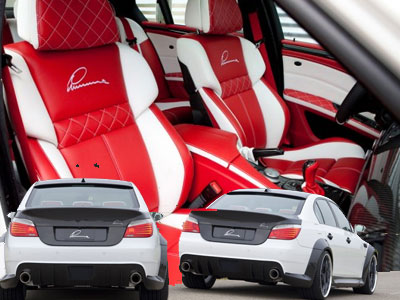
2009 Lumma CLR 730 RS based on the BMW M5 E60 One of the Fastest Sports Car Limousine worldwide.2

2009 Lumma CLR 730 RS


2009 Lumma CLR 730 RS, One of the fastest limousine worldwide, With a unique combination of High Tech engineering and an innovative, solely for maximum power constructed design, LUMMA Design introduces, in cooperation with G-Power. Do you need a true-bred sports car for a spectacular appearance? By no means! With this unique sports limousine CLR 730 RS LUMMA Design, basic vehicle BMW M5 E60, benches many sport cars. Ten cylinders, bi compressor engine, 730 hp and 700 Nm. Is there any room for improvement? Definitely not! The new LCR 730 RS from LUMMA Design is a commitment to racing. But also concerning style and luxury the CLR 730 RS goes strong.
2009 Lumma CLR 730 RS

Aerodynamics is of elementary importance to get a more then 360 km/h maximum speed. The body of the BMW M5 is improved with ultra light but extremely compact carbon components. The LUMMA Bodykit "CLR 730 RS" consist of a hood, a trunk lid with integrated tearing edge, mirror caps, door handles, entrance strips and fenders - all made of carbon.
Extra light and forged wheels were produced for the ultra broad track. On the front axle are LUMMA Racing rims in 10x21" with tires size 255/30-21, on the rear axle 12Jx21 with tires from Michelin size 295/25-21. The wheelwork is three piece crafted, the rim star is forged, and dull black anodized and has stainless steel outer rims.

2009 Lumma CLR 730 RS

The combination of lightweight, enormous engine power and innovative aerodynamics the LUMMA CLR 730 RS from Winterlingen achieves acceleration times which were so far only subject to true race cars. The 730 hp V10 bi-compressor engine obstructed from G-power is the most powerful engine that has ever been obstructed into a road-legal BMW. Off the top off one's head the car catapults itself within 4.2 seconds up to speed 100. After 10 seconds the sport limousine has already doubled the speed. After 29.5 seconds the car achieves 300 km/h. Top speed is at 367,4 km/h. This power explosion is traced back to the core of the G-Power compressor system, the ASA radial compressor. Also used is a LUMMA sport exhaust system with 100 cells racing catalysts and 105 mm end pipes made of stainless steel and engraved LUMMA logo.
2009 Lumma CLR 730 RS

The LUMMA Bodykit “CLR 730 RS” consist of a hood, a trunk lid with integrated tearing edge, mirror caps, door handles, entrance strips and fenders – all made of carbon. The Lumma CLR 730 RS sport suspension is multiple adjustable on both axles in bound and rebound and lowering the car up to 45 mm. On the front axle are LUMMA Racing rims in 10×21″ with tires size 255/30-21, on the rear axle 12Jx21 with tires from Michelin size 295/25-21.

Saturday, October 10, 2009

Shelby GT500KR Ford Mustang Sports Car (King of the Road)


Shelby GT500KR Ford Mustang Sports Car

King of the Road
The 2008 Ford Mustang Shelby GT500KR is a limited edition performance model limited to just 1000 units. The launch of the GT500KR at the 2007 New York International Auto Show was designed to coincide with the 40th anniversary of the original 1968 Shelby GT500KR.
The bulging vented hood, styled after the original, is secured by a pair of stainless steel, twist-down hood pins. The composite front valance houses a pair of chrome-trimmed, functional brake ducts to cool the large 14-inch, vented Brembo front brakes.
The Ford SVT-engineered 5.4-liter supercharged V-8 under the GT500KR's hood is treated to a Ford Racing Power Upgrade Pack that boosts horsepower to an estimated 540 and torque to 510 ft-lbs, thanks to revised ignition and throttle calibration and a cold air intake system that replaces the stock unit.
Shelby GT500KR Ford Mustang Sports Car

Power is delivered to the rear wheels of the GT500KR through a Tremec TR6060 six-speed manual transmission and 3.73:1 rear axle ratio, upgraded from the standard GT500's 3.31:1. Gear selection is courtesy of an all-new Ford Racing short-throw shifter making its debut on the KR. Topped with a white ball, the new shifter is 25 percent shorter than the unit on the GT500 providing for crisper, sharper shifts.
Ford SVT, Ford Racing and Team Shelby worked together to develop the GT500KR's suspension tuning. Based on initial work by Ford Racing and the team at Shelby, often at Shelby's own facility on the grounds of Las Vegas Motor Speedway, Ford SVT chassis engineers will apply fine tuning techniques to prepare it for the streets. The Shelby GT500KR will feature unique spring rates, dampers, stabilizer bars, and strut tower brace, all designed specifically for the KR, to deliver the precision handling package.

Tuesday, September 29, 2009

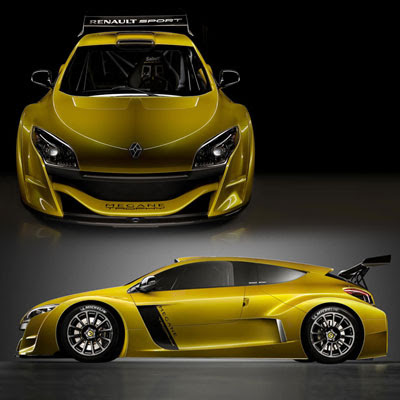
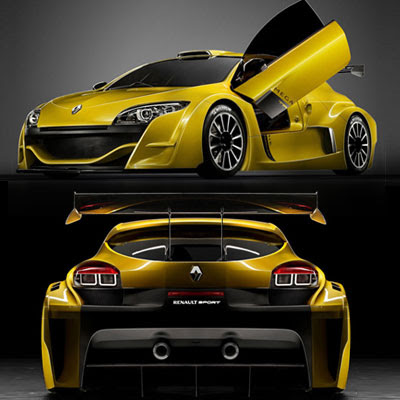
2009 Sport Car Renault Megane Trophy

The 2009 Megane Trophy will go on sale at the end of the year in the form of kit after the completion of its development programme which will enable existing cars to be upgraded.
The 2009 Renault Megane Trophy is based on the new Megane Coupe which is powered by the Renault-Nissan Alliance’s mid-rear 3.5-liter V6 24V engine that produces 360 hp.
The front and rear light units and windscreen are from the Megane Coupe road car while flowing lines of the bodywork was designed from digital simulation technology to improve the aerodynamic.
The Renault Megane Trophy features front splitter which channel air flow to the extractors and rear diffuser and wing that generated downforce. Downforce has improved by 20 % with the refinements to the set-up and drag was reduced by 15 % , which together, represent a gain of almost 40% in terms of the new car’s aerodynamic performance over the previous generation vehicle.

Apart from that, the Megane Trophy also features butterfly doors reminiscent of the world of GT and sports-prototype racing. The V6 3.5 24V engine is mated to a semi-automatic gearbox with the same mechanical features as the current car, including an FIA-homologated sports-prototype tubular chassis, steering wheel-mounted paddle shift, double wishbone suspension with adjustable dampers, 18-inch wheels and Michelin tires.
The power of the standard 330 hp engine was boosted to 360 hp with the help from the new inlet manifold. Rebuild is still at every 5,500 km for the car’s reliability. According to Renault, with the new aerodynamic gains, the extra power from the engine will enable the 2009 Renault Megane Trophy to lap in similar times to those of a Porsche GT3.